

In the rapidly shifting landscape of 2026, the “Amazon effect” has reached a fever pitch. Consumers no longer just demand speed; they demand hyper-personalization and variety. For e-commerce fulfillment centers, this has birthed the “High-Mix, Low-Volume” (HMLV) challenge. Managing thousands of different SKUs, varying box sizes, and fragile items in small batches is a logistical nightmare for traditional, rigid automation.
The solution has arrived in the form of cobot packaging. Unlike the monolithic robots of the past, the modern industrial collaborative robot is built for agility. By following industry best practices and leveraging high-performance hardware like the JAKA Zu 30, fulfillment centers can transform a chaotic packing line into a streamlined, future-proof operation.
1. Prioritize Flexibility Over Raw Speed
In a high-mix environment, the ability to switch between tasks is more valuable than the ability to perform one task at maximum velocity. Traditional industrial welding robots or heavy-duty sorters are often “locked” into a specific path. In contrast, cobot packaging thrives on “Plug-and-Play” deployment.
Best Practice: Design your workstations for rapid changeover. Use universal grippers (such as vacuum or soft-fingered effectors) that can handle anything from a heavy bottle of detergent to a lightweight electronics box without mechanical adjustments. The goal is to reduce “downtime” during SKU transitions to near zero.
2. Leverage High-Payload Cobots for End-of-Line Efficiency
A common misconception is that cobots are only for small, delicate items. However, in e-commerce fulfillment, the real bottleneck often occurs at the end of the line—palletizing heavy, mixed-SKU boxes. This requires a robot that possesses the safety of a cobot but the strength of an industrial machine.
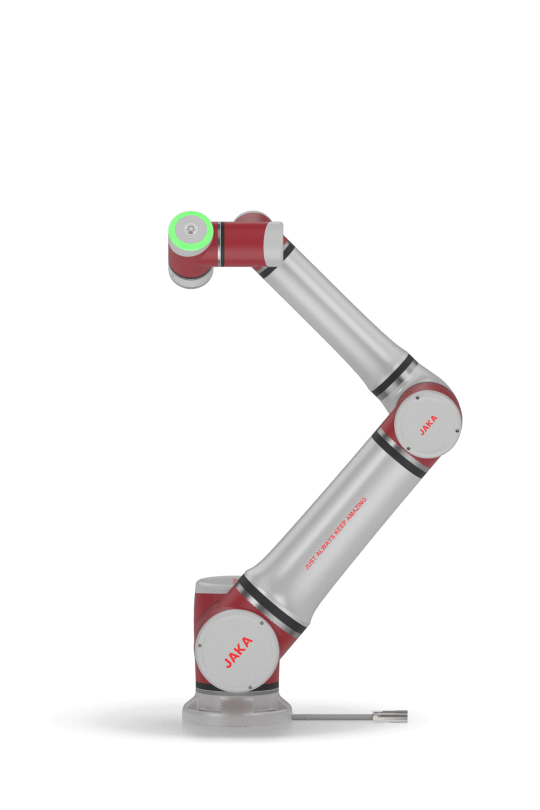
The JAKA Zu 30 is specifically engineered for these heavy-duty collaborative scenarios. With a market-leading 30 kg payload and a 1350 mm reach, it can handle the large, multi-item cartons typical of bulk e-commerce orders.
Why the JAKA Zu 30 is a Game Changer for HMLV:
Heavy-Duty Handling: While most cobots max out at 10–15 kg, the Zu 30 manages 30 kg, allowing it to palletize heavy household goods or bulk shipments that previously required a caged industrial robot, enhancing operational efficiency and enabling safer collaboration with workers while maintaining smooth motion control, reliable cycle times, and consistent performance across diverse logistics and warehouse environments everyday industrial workflows seamlessly.
Compact Precision: Despite its power, it maintains a repeatability of ±0.05 mm, ensuring that boxes are stacked with mathematical stability, reducing transit damage.
3. Implement “Fenceless” Collaborative Cells
One of the greatest costs in fulfillment is floor space. Traditional automation requires “safety zones” and steel cages. In a high-mix warehouse, you need your human workers to be able to move freely to handle exceptions or perform quality checks.
Best Practice: Utilize the built-in safety sensors of your industrial collaborative robots. The JAKA Zu series features advanced collision detection that allows the robot to work side-by-side with humans. If a worker bumps into the arm or enters a restricted zone, the robot stops or slows down instantly. This “fenceless” design can reclaim up to 50% of the floor space compared to traditional robotic cells.
4. Integrate AI-Driven Vision Systems
High-mix fulfillment means the robot often doesn’t know exactly what is coming down the conveyor belt. Is it a polybag? A cardboard box? A cylinder?
Best Practice: Pair your cobot packaging system with AI-powered 2D or 3D vision. A vision-equipped JAKA Zu 30 can “see” the dimensions and orientation of an incoming item and adjust its grip and placement logic in real-time. This eliminates the need for expensive, custom jigs for every SKU and allows the robot to handle the “randomness” of modern e-commerce.
5. The Hybrid Advantage: Human-Robot Synergy
The most successful fulfillment centers in 2026 don’t try to automate everything. They automate the “3Ds”: tasks that are Dull, Dirty, or Dangerous.
Best Practice: Let the cobot handle the heavy lifting (palletizing) and the repetitive taping or labeling, while the human operator focuses on “high-touch” tasks like gift-wrapping or verifying the aesthetic quality of an unboxing experience. The JAKA Zu 30, with its IP65 protection, can operate in the dustier, tougher areas of the warehouse where human comfort might be compromised, freeing your staff for more value-added roles.
6. Planning for Multi-Process Deployment
Because HMLV demand fluctuates, a robot that only does one thing is a wasted asset. One day you might need extra help in packaging; the next, you might need assistance in a manufacturing sub-assembly area.
Interestingly, the technology found in a high-end industrial welding robot—such as high-torque joints and precise path-following—is now present in cobots like the JAKA Zu 30. This means the same robot you use for packing during the holiday rush can be redeployed for high-precision tasks like high-torque fastening or even light welding during slower seasons. This versatility ensures a much faster Return on Investment (ROI) than single-purpose machines.
