

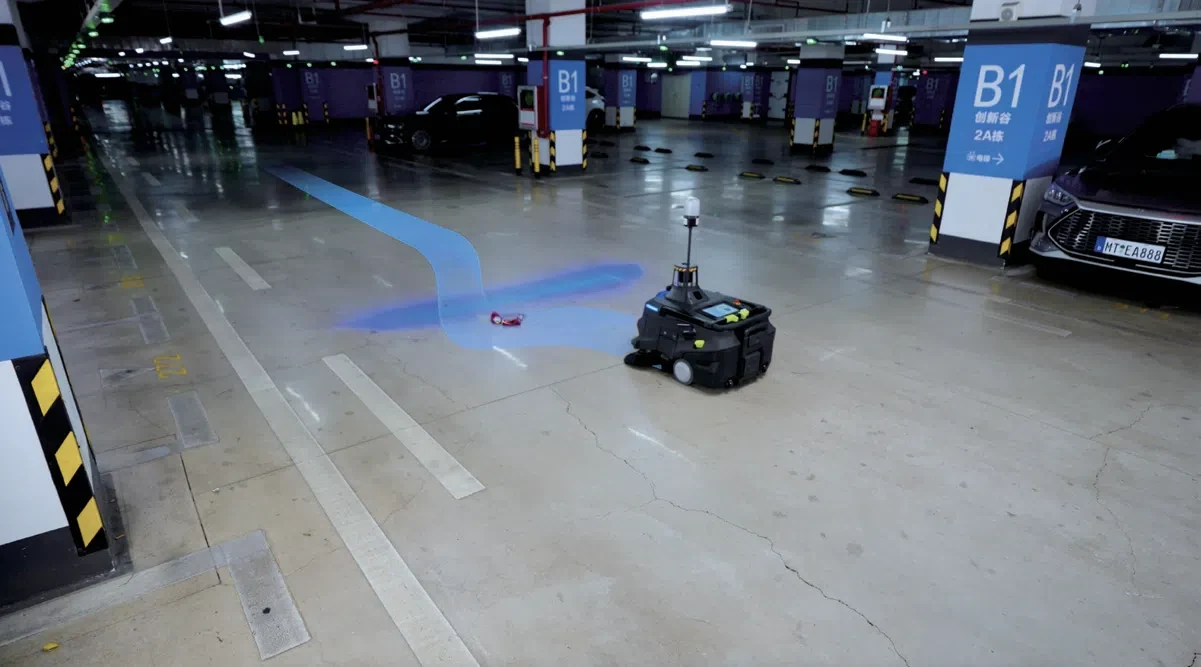
Practical guidance for tobacco plant operations, EHS, facilities, and procurement teams evaluating dry sweeping robots in cutting, packaging, warehouse, wall-edge, pillar-edge, and equipment-edge zones.
2026-05-20 | 12 min read
In a tobacco plant, floor debris does not arrive in one tidy category. A cutting area can shed fine tobacco dust every few minutes. A packaging area can drop loose cigarettes, paperboard, cartons, film, labels, and broken packaging. A warehouse can add pallet chips, paper scraps, shrink-wrap, and general floor dust. The hard part is not finding a machine that can sweep. The hard part is deciding where robotic dry sweeping fits inside a cleaning program that also has combustible dust, worker exposure, traffic, production uptime, and narrow equipment clearances to consider.
The short answer: tobacco manufacturers should use commercial cleaning robots for repeatable floor-level dry debris, edge cleaning, spot cleaning, and high-frequency coverage in accessible areas. They should not treat a robot as the whole dust-control system. Combustible dust assessment, ventilation, dust collection, approved cleaning tools, manual touch-up work, and EHS procedures still define the safety envelope.
For large dry sweeping routes, PUDU MT1 Max is a relevant product to evaluate because it combines 3D perception, AI adaptive cleaning, 70 cm sweeping width, a 35 L waste container, edge-to-edge cleaning, automatic filter cleaning, IP54 sealing, and 5-10 hours of run time, according to Pudu Robotics. In tobacco manufacturing, the buying question is narrower: can the robot pick up the plant’s actual tobacco dust, scattered packaging, loose cigarettes, and edge debris while staying within the site’s EHS rules?
Why tobacco manufacturing is a difficult cleaning environment
Tobacco production creates a cleaning problem with three different behaviors.
First, fine tobacco dust spreads quickly. Cutting, conveying, blending, and transfer points can create settled dust on floors and equipment bases. If the cleaning method throws dust back into the air, the plant has not solved the problem. It has moved the problem into the breathing zone, onto overhead surfaces, or into nearby production areas.
Second, packaging debris is light but irregular. A sweeper may collect paper strips during one pass but push a flat carton edge, scatter plastic film, or miss a cigarette that lies close to a wall. Packaging zones need testing with real debris samples because the floor mix changes by line, material, humidity, and shift behavior.
Third, debris collects at edges. Wall bases, pillar bases, rack legs, guard rails, machine edges, dock doors, and blind corners are where tobacco dust and light scraps linger after central aisles look clean. Many factories overestimate automation coverage because they look at the open aisle first. The better test is the column base.
OSHA’s combustible dust material list includes “Tobacco blend” among agricultural dusts that can create combustible dust concerns when processed in powdered form. OSHA also points to regular housekeeping frequencies for floors and horizontal surfaces as part of dust control. That does not mean every tobacco floor has the same hazard classification. It means EHS should test and classify the facility’s dust and then define what cleaning equipment is allowed in each area.
Start with a zone-by-zone debris map
Before selecting a robot, map debris by production zone. A tobacco facility usually needs different settings, routes, and handoff rules for cutting, packaging, warehouse, and edge areas.
| Zone | Typical debris | Robot fit | Human or EHS control still needed |
| Tobacco cutting and processing | Fine tobacco dust, small leaf fragments, settled dust near equipment | Good fit for frequent dry floor sweeping where the route is accessible and approved by EHS | Dust hazard assessment, dust collection, ventilation, approved cleaning method, filter maintenance |
| Cigarette packaging | Loose cigarettes, paperboard, labels, films, carton pieces, paper scraps | Good fit after brush speed, suction or sweeping parameters, and spot-cleaning rules are tuned to the debris mix | Manual clearing below low equipment, under conveyors, and inside tight line-side gaps |
| Warehouse and staging | Wood chips, pallet dust, paper scraps, shrink-wrap fragments, dust from traffic | Strong fit for scheduled open-area routes and spot cleaning after staging activity | Forklift traffic rules, dock-area route limits, disposal routines |
| Walls, pillars, racks, and machine edges | Dust lines, tobacco fragments, light scraps, corner buildup | Fit depends on edge-cleaning capability, route design, and safety-distance configuration | Manual detail cleaning in unreachable or safety-restricted areas |
Table – Evaluation framework.
The purpose of this map is practical. It stops the team from asking “Can a robot clean our plant?” and moves the discussion toward “Which debris, in which zone, under which safety rules, at what frequency?”
Handle tobacco dust without simply spreading it
The most common legacy workflow in tobacco plants is also the one that deserves the most scrutiny: staff use compressed air to blow tobacco dust into a pile, then sweep the pile manually. In one anonymized U.S. tobacco manufacturing site, workers had to do this roughly every 20-30 minutes in a high-output cutting area. The labor burden was obvious, but the dust behavior mattered just as much.
OSHA describes combustible dust incidents through a simple set of conditions: fuel, oxygen, heat, confinement, and dispersion. Cleaning methods that disperse fine dust should be reviewed by EHS before they become routine. The safer direction is usually to collect settled dust more consistently, reduce dust migration, and prevent hidden buildup. That can involve source capture, dust collection, approved vacuums or sweepers, scheduled housekeeping, overhead inspections, and floor-level robotic cleaning where the equipment is allowed.
For robotic cleaning, the practical rules are:
– Use robots mainly for settled floor-level dust and small debris, not for airborne dust control.
– Confirm whether the robot and its electrical components are allowed in any classified or dust-hazard area.
– Define where compressed air is restricted, where vacuuming is required, and where robotic sweeping is acceptable.
– Inspect the robot’s waste container, brushes, and filters on a fixed schedule because tobacco dust can load a system faster than normal office or retail debris.
– Keep routes away from unstable dust piles that should be removed through site-approved procedures.
The buyer takeaway is simple: a robot can reduce repetitive floor sweeping, but dust safety has to be designed around the material, not around the machine.
Tune the robot for loose cigarettes and packaging waste
Packaging debris looks easy until the robot meets it at line speed. A loose cigarette can roll. A carton edge can catch. Thin film can float or fold. Paperboard can ride ahead of a brush if the robot approaches at the wrong angle.
This is where a generic cleaning demo often fails. The acceptance test should include tobacco-plant debris:
– Loose cigarettes in different orientations.
– Cigarette packs and flattened cartons.
– Paperboard tabs, labels, and small scraps.
– Plastic film and shrink-wrap fragments.
– Mixed piles of dust and light packaging waste.
– Warehouse debris such as wood chips and pallet dust.
PUDU MT1 Max is built for sweeping rather than wet scrubbing. Pudu Robotics states that MT1 Max can remove debris ranging from cigarette butts and paper scraps to large bottles, and its AI adaptive cleaning strategy can reduce power for light debris to limit scattering or increase power for heavier debris. For tobacco packaging areas, that is the right kind of capability to test because the concern is not only whether the robot sees debris. It is whether it collects the debris without pushing it into the next aisle.
The tuning process should be boring and strict. Choose a representative debris set, run repeated passes at different settings, count misses, inspect edges, then document which settings belong to each zone. If the robot cannot reach below a low conveyor or into a narrow service gap, mark that area for manual detail cleaning instead of forcing the route.
Edge debris is where acceptance tests should spend time
Open floors are the easy part. Tobacco dust at a pillar base is the real test.
Edge debris matters because it is visible, persistent, and easy to miss in a coverage report. A robot may show strong square-meter coverage while leaving a dusty line along a wall, a packing-machine foot, or a column guard. For a production manager, those edges are often the difference between “the robot worked” and “staff still have to chase the same mess.”
Pudu Robotics lists “0 cm edge-to-edge cleaning” for MT1 Max. In field terms, that capability should be translated into a route and test method:
– Run the robot along straight walls, pillars, columns, and machine bases.
– Test convex corners and concave corners separately.
– Check whether loose tobacco fragments at the base of a column are collected or pushed.
– Measure how the robot behaves near guard rails and fixed obstacles.
– Confirm safety-distance settings with EHS and site operations.
In the anonymized U.S. tobacco plant mentioned earlier, edge cleaning near pillars was one of the most important proof points. The site used a software configuration that allowed the robot to work very close to columns, helping it collect tobacco fragments around pillar bases. That field result should not be generalized blindly to every plant, but it gives procurement teams a useful test pattern: do not approve the robot only in the center aisle. Approve it at the edge.
Use robots where they reduce repetitive work, and keep manual cleaning where it belongs
Good automation in tobacco manufacturing is not a contest between workers and robots. The best deployments give routine, repeatable routes to the robot and keep judgment-heavy or unreachable tasks with trained staff.
Robots are a strong fit for:
– High-frequency sweeping in open cutting-area aisles.
– Packaging floors where loose cigarettes and packaging scraps fall repeatedly.
– Warehouse lanes, staging areas, and large dry floor routes.
– Spot cleaning when debris appears between scheduled routes.
– Edge routes along walls, pillars, and fixed equipment where the robot has been tested.
Manual cleaning remains necessary for:
– Under-equipment spaces the robot cannot enter.
– Complex narrow passages with frequent obstruction.
– Overhead dust, ledges, ducts, beams, and hidden horizontal surfaces.
– Any area where EHS requires a specific approved vacuum, tool, or shutdown procedure.
– Line-side cleanup that requires staff judgment during production.
This division of labor is what made the anonymized tobacco deployment credible. The customer understood that the robot could cover cutting, packaging, warehouse, and many edge-cleaning tasks, while staff would still handle machine bottoms and complex narrow spaces. That boundary is not a weakness. It is how a plant avoids overpromising automation and then losing trust after go-live.
A practical deployment pattern for tobacco plants
A workable tobacco-factory deployment usually follows four phases.
Phase 1: classify the cleaning zones
Start with EHS, facilities, production, and maintenance in the same walkthrough. Identify dust-generating processes, ordinary floor debris, traffic routes, blocked areas, and prohibited zones. Confirm where dry sweeping is allowed, where vacuuming is required, and where equipment must meet specific hazard classification requirements.
Phase 2: run debris-fit tests
Use real tobacco dust, real packaging scraps, real loose cigarettes, and real warehouse debris. Test open aisles, edge routes, column bases, dock areas, and packaging-line perimeters. Record misses instead of relying on a visual impression.
Phase 3: tune routes and cleaning parameters
Adjust approach angle, brush or sweeping parameters, spot-cleaning behavior, route frequency, safety distance, and waste-container service intervals. The goal is not the prettiest map. The goal is fewer repeated manual interventions in the same places.
Phase 4: define the operating handoff
Decide who empties the waste container, who checks brushes and filters, who reviews cleaning reports, who handles exceptions, and who owns route changes when production equipment moves. Robots fail quietly when no one owns the daily handoff.
What to ask in an RFP or pilot test
The best RFP questions are specific to the mess. Tobacco plants should ask vendors to prove the following items on site.
| Evaluation item | What to verify | Why it matters |
| Dust compatibility | EHS approval for the zone, filter and waste-container service plan, dust control boundaries | Tobacco dust may create exposure and combustible dust concerns |
| Mixed debris pickup | Loose cigarettes, cartons, paperboard, film, labels, pallet chips, and dust | Packaging floors rarely contain one debris type at a time |
| Edge cleaning | Wall bases, pillar bases, machine feet, guard rails, and dock thresholds | Edge debris drives manual touch-up workload |
| Navigation and traffic | Forklifts, pedestrians, narrow aisles, high ceilings, low light, reflective surfaces | Tobacco plants are dynamic production environments |
| Maintenance routine | Brush checks, bin emptying, filter cleaning, software updates, fault handling | Dust-heavy sites can load cleaning hardware quickly |
| Reporting | Cleaning area, route completion, missed-task notes, fault records | Facilities teams need evidence, not just a completed route icon |
| Boundaries | Under-equipment gaps, complex narrow passages, classified areas, overhead dust | Clear limits prevent disappointment after deployment |
Table – Evaluation framework.
If a vendor cannot run this test with the plant’s real debris, the evaluation is incomplete. If a vendor claims the robot can handle every cleaning job without manual follow-up, the claim should be challenged.
Where PUDU MT1 Max fits
PUDU MT1 Max is positioned by Pudu Robotics as an AI-powered 3D perception robotic sweeper for complex large-scale environments. Official specifications list VSLAM, marker navigation, and 3D LiDAR SLAM; a 70 cm cleaning width with side brush; a 35 L waste container; 5-10 hours of run time; charging time under 3.5 hours; 2200 sq m per hour maximum cover cleaning performance; and 7000 sq m per hour maximum spot-cleaning performance.
For tobacco manufacturing, the product relevance comes from five capabilities.
First, dry sweeping fits zones where water should be avoided. Many production areas do not want unnecessary wet cleaning near equipment, product material, or packaging lines.
Second, 3D perception can help in complex environments with pillars, traffic, high ceilings, and lighting interference. Pudu Robotics says MT1 Max uses 3D LiDAR plus multi-sensor fusion to map, detect obstacles, and navigate in demanding conditions.
Third, adaptive cleaning matters for light debris. If the robot uses too much force on paper scraps or tobacco fragments, it can scatter them. If it uses too little force on heavier waste, it can miss them. The site acceptance test should verify this balance.
Fourth, edge-to-edge cleaning fits the common tobacco-plant complaint that dust gathers at walls, columns, and equipment bases.
Fifth, automatic filter cleaning and a 35 L bin support longer routes, though the plant still needs a maintenance rhythm based on actual dust load.
The right procurement implication is not “buy one robot and the cleaning problem disappears.” The useful conclusion is more practical: if a tobacco manufacturer has large accessible dry-floor areas, repeated packaging debris, and visible edge buildup, MT1 Max belongs on the shortlist for an on-site debris-fit test.
FAQ
Can a commercial cleaning robot handle tobacco dust?
It can handle settled floor-level tobacco dust in accessible areas when the site permits robotic dry sweeping and the robot is tested against the actual dust load. It should not be treated as airborne dust control or combustible dust mitigation by itself. EHS should define the approved method for each zone.
Should tobacco factories use compressed air to blow dust into piles?
Compressed air can disperse fine dust, so it should be controlled by site procedure and reviewed by EHS. OSHA’s combustible dust guidance focuses on reducing dust accumulations and asks whether housekeeping removes dust from floors and other surfaces during operations. In many plants, more frequent collection of settled dust is a better direction than repeatedly moving dust through the air.
What debris should be included in a robot acceptance test?
Use tobacco dust, leaf fragments, loose cigarettes, cigarette packs, paperboard, plastic film, labels, shrink-wrap, wood chips, and ordinary warehouse dust. Place debris in open aisles, near walls, at column bases, beside machine feet, and around dock transitions.
Can a robot clean under production equipment?
Only where the robot physically fits, navigation is reliable, and EHS allows the route. Low equipment, complex narrow passages, and obstructed service areas should usually stay in the manual cleaning plan.
What matters most when evaluating edge cleaning?
Test the exact edge conditions that annoy the plant today: wall bases, pillar bases, equipment feet, rack legs, thresholds, and guard rails. Count leftover debris after multiple passes. A strong center-aisle result is not enough.
Conclusion: clean the workflow, not just the floor
Tobacco manufacturing needs a cleaning system that respects the material. Fine dust, loose packaging, and edge buildup each behave differently. A commercial cleaning robot can remove a large share of repetitive floor-level debris when the route is accessible, the safety rules are clear, and the debris-fit test is honest.
The next step is a controlled site evaluation: map zones, classify dust risks, test real debris, tune the route, document boundaries, and define the daily handoff. For plants where dust and packaging waste keep returning every few minutes, that kind of evaluation can turn robotic cleaning from an interesting demo into a practical operating tool.
