

Germany has become an important proving ground for residential energy storage, where strong market presence depends on more than battery shipments alone. Suppliers must support installers, provide adaptable system solutions, and maintain the infrastructure required after installation.
Against this backdrop, Fox ESS achieved a notable milestone: S&P Global Energy’s Residential Energy Storage Market Tracker ranked the company No. 1 in Germany by residential storage shipments in 2025. The same ranking placed it first globally and in the UK.
That result provides a clear measure of commercial momentum. More importantly, the company’s German position is supported by a broader residential product strategy and an increasingly localized approach to the installer channel.
Germany Has Become a Strong Indicator of Residential Storage Position
Shipment rankings do not measure every aspect of a storage supplier’s performance. They do, however, show the scale of equipment reaching a particular market. The reported German No. 1 position therefore offers tangible evidence that Fox ESS has established substantial residential storage penetration in the country.
The German result also forms part of a wider European pattern. During H1 2025, Fox ESS reported No. 1 positions across Europe, the UK, and Poland based on residential storage shipments measured in MWh. Its subsequent 2025 ranking extended that reported leadership to Germany and the UK as well as the global market.
Such consistency matters commercially. A supplier that can achieve shipment scale across several markets is demonstrating more than isolated demand; it suggests the underlying sales and distribution structure can support residential storage at significant volume.
A Residential Portfolio Built Around System Integration
A household battery is rarely deployed independently. Residential projects can combine solar generation, battery storage, inverters, EV charging, heat pumps, and digital energy management. Suppliers that can connect several of these elements have an opportunity to address the household energy system more comprehensively.
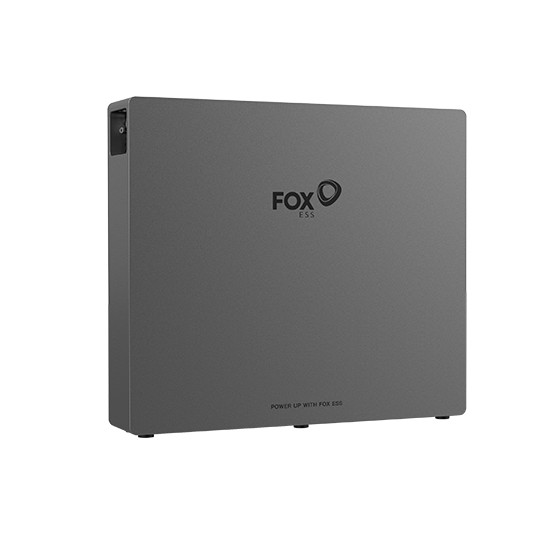
Fox ESS has developed a portfolio spanning batteries, PV and hybrid inverters, EV chargers, heat pumps, and the FoxCloud 2.0 energy-management platform. Its battery offering is therefore positioned within a broader residential energy ecosystem rather than as a standalone hardware category.
That positioning is relevant to homeowners seeking a storage battery because the storage unit is only one part of the energy-flow architecture. The inverter manages conversion, the battery stores available energy, and energy-management functions can provide visibility over system operation. A broader portfolio gives installers more opportunities to design around the actual configuration of a home.
For distributors and installers, the same structure can simplify supplier relationships when several household energy technologies are being considered within one project. It also gives Fox ESS a stronger platform for cross-category engagement than a business focused solely on battery hardware.
Scalable Batteries Give Installers More Design Flexibility
Residential demand is not uniform. A compact household with modest electricity consumption has different storage requirements from a larger property with substantial PV generation or additional electrification loads. A single battery format would therefore be poorly suited to a market with varied project requirements.
The published Fox ESS battery portfolio addresses this issue through multiple residential storage solutions and expandable system configurations. Product documentation covers different models and capacities, giving installers a range of options when assessing household storage requirements.
This flexibility strengthens the practical proposition of an energy storage battery because system sizing can be considered around the project rather than forced into one fixed configuration. Installers can evaluate storage capacity alongside the household’s generation profile, consumption pattern, available installation space, and wider system architecture.
Product breadth also supports a more adaptable sales conversation. Instead of positioning residential storage as a single standardized purchase, Fox ESS can approach the market through a portfolio capable of serving different system designs.
Local Installer Support Strengthens the Route to Market
Germany’s residential storage market is ultimately built through installations. Homeowners may initiate the purchase decision, but installers have a central role in system selection, configuration, commissioning, and ongoing technical support.
That makes the company’s German installer strategy particularly relevant. Fox ESS reported that its dedicated installer partner program was launched in Germany in late 2025, providing training, support, networking opportunities, and partner benefits. The program was designed to strengthen relationships with professional installers and subsequently expand into other markets.
The initiative complements the company’s product strategy. A broad portfolio has greater commercial value when installers understand how to specify and deploy it effectively. Training and technical resources can reduce friction during the transition from product selection to completed residential installation.
Local engagement can also help establish longer-term channel relationships. For a supplier competing in a mature market, sustained installer confidence can be as important commercially as achieving high shipment volume in a single reporting period.
Global Scale Gives the German Strategy More Weight
Germany is not operating as a separate story from the company’s international development. Fox ESS reported that its global residential storage market share increased by 50% in 2025 compared with 2024. The company also stated that its global workforce exceeded 5,000 employees by April 2026.
The same source reported more than 400 R&D specialists working on product development and described the use of feedback from real-world installations to inform product refinement.
For a residential storage provider, that connection between international deployment and product development can support continuous adaptation to different household requirements.
Global scale does not automatically establish product superiority. It does, however, provide context for the German ranking: the market position is emerging alongside significant international operations and investment rather than from a narrowly focused local sales push.
A Stronger Position Built Around the Whole Home Energy System
Germany’s reported No. 1 residential storage ranking is therefore best viewed as the result of several reinforcing elements. Shipment scale establishes the market evidence, while a broad residential portfolio, scalable battery choices, installer engagement, and wider organizational resources provide supporting commercial infrastructure.
For homeowners evaluating a solar storage battery, the ranking should not replace project-specific assessment. Household energy demand, PV generation, system configuration, installation conditions, and service arrangements still determine whether a particular solution is appropriate.
For installers and distributors, however, Fox ESS presents a broader proposition: batteries are combined with inverters, EV charging, heat pumps, and energy-management capabilities within one residential energy portfolio. That ecosystem approach can create more opportunities to address the complete household energy system rather than an isolated storage requirement.
The German milestone consequently represents more than a shipment statistic. It shows that Fox ESS has established substantial traction in a strategically important residential market while building the product and installer infrastructure needed to support further growth.
With Germany now among its reported leading markets, the company’s position reflects a strategy centered not simply on selling batteries, but on becoming a broader participant in the home energy transition.
