

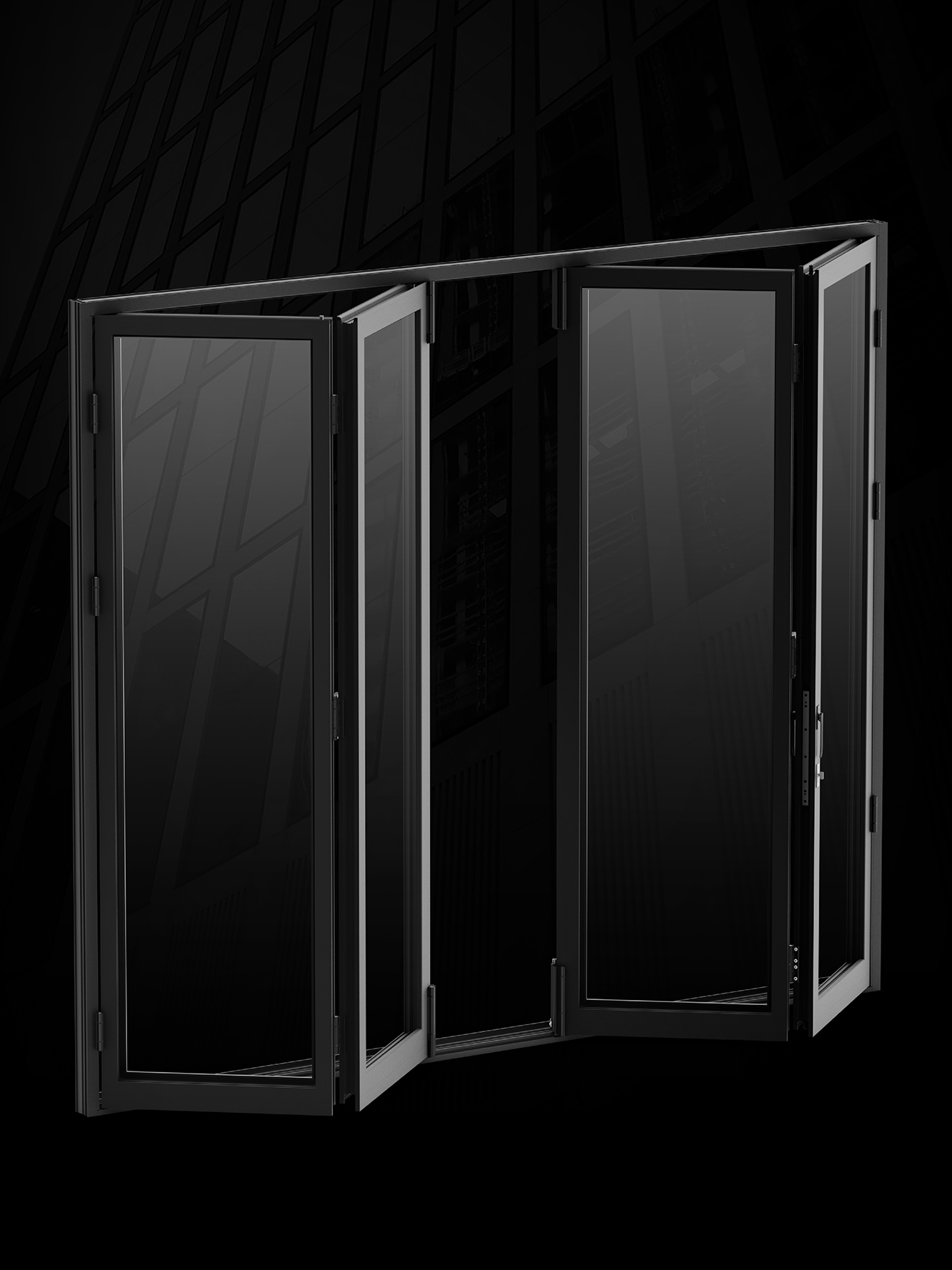
A double inswing casement window delivers an uninterrupted aperture by removing the fixed central mullion. This choice transfers significant sealing responsibility from the frame to the internal hardware solution. It requires a coordinated mechanical system capable of securing two independently hinged leaves.
CMECH engineers specific inswing casement window hardware solutions for this dual‑leaf challenge. The system combines a 100 kg‑rated hinge platform per sash with extended transmission rods and multi‑point locking coordination. When paired with compliant profiles and precise fabrication, this enables both the primary active sash and the secondary inactive leaf to compress their perimeter seals effectively under dynamic loads.
Two-Leaf Geometry in a Double Inswing Casement Window
The visual advantage of a double inswing casement window is the unobstructed opening created when both sashes swing inward. This setup connects environments without a structural mullion. This geometry is frequently specified for luxury residential living rooms and high-end terraces where expansive views are prioritized.
Removing the mullion takes away the traditional resting surface that a single sash closes against. The hardware must generate compression along a meeting stile that functions as a moving component. This arrangement demands precise coordination of lock points, astragal alignment, and hinge geometry to mitigate weather bypass.
The Astragal Bar and Structural Meeting Surfaces
To restore the sealing function lost with the mullion, two-leaf systems incorporate an astragal bar mounted on the meeting stile of the secondary sash. When the primary leaf closes against this bar, it establishes a stable resting surface, allowing the gasket to compress uniformly along the edge.
The astragal integrates sealing gaskets along both of its structural faces. One side compresses against the primary sash, while the other seals against the frame jamb. This design transforms the meeting line from a potential leakage pathway into a robust thermal barrier, supporting the assembly’s weatherproofing integrity.
CMECH hardware coordinates lock-point timing during the closing sequence. This engineering detail aims to ensure internal astragal seals engage just before outer frame perimeter seals reach full compression. Such timing is designed to prevent structural bypass that might occur if both surfaces compressed simultaneously.
Primary and Secondary Sash Mechanical Coordination
The primary active leaf houses the main handle and the central multi-point locking system. The secondary inactive leaf relies on concealed locking points, which typically include sturdy shootbolts. These mechanisms secure the top and bottom edges of the secondary panel firmly into the structural frame.
Without dual-lock architecture, the inactive leaf would remain susceptible to rattling under wind loads. By utilizing extended transmission rods, CMECH ensures main handle rotation smoothly coordinates primary lock engagement with secondary-leaf shootbolt deployment through one unified mechanical input.
The dedicated gearbox, which undergoes rigorous 30,000-cycle‑tested validation, delivers consistent force distribution. Thanks to this capability, both leaves achieve comprehensive seal compression in a single motion. It enables secure closure without requiring occupants to latch each leaf independently, streamlining daily operation.
Load-Bearing Hinge Assemblies for Dual Configurations
A two-leaf configuration concentrates roughly twice the glass weight onto the outer frame jambs. Because both sashes open inward, each hinge pair must resist the full cantilevered load of its respective panel without the benefit of gravity-assisted closing forces.
If underspecified components are used, the system may develop progressive sag that eventually misaligns the astragal. To counter this, CMECH provides a 100 kg‑rated hinge platform per sash, featuring multi‑dimensional adjustment and a specialized anti‑sag structure. When paired with compliant profiles and proper installation, this hardware allows installers to align both sashes to a common plane effectively.
This adjustable hinge gap can be precisely matched to the specific weatherstrip compression ratio. This calibration helps ensure that both astragal seals and perimeter gaskets compress safely to their intended design limits without transferring excessive loads onto the delicate hinge pivots.
Perimeter Sealing and Meeting-Stile Weatherproofing
The meeting stile between two inward-opening sashes represents a highly vulnerable junction within the building envelope. It must seal tightly against a moving partner rather than a rigid frame. Furthermore, exterior wind pressure tends to drive rainwater directly toward the central astragal line where gasket surfaces meet.
The inswing casement window hardware solution engineered by CMECH addresses this through a multi-point mechanism featuring rolling-friction engagement and durable stainless steel rivets. This setup generates the compressive force necessary to seat dual-durometer gaskets securely along astragal faces, supporting reliable long-term performance.
The coordinated lock-point timing creates a cascading pressure gradient across the sealing lines. By ensuring the meeting-stile seal reaches its design compression first, the system presents a strong defense against wind-driven moisture. This methodical sealing approach is highly beneficial for high-rise façades experiencing positive pressure differentials.
Installation Alignment and Dual-Sash Synchronization
Double inswing units demand millimeter-level alignment between the two interacting sashes across both the central meeting stile and the outer perimeter frame. Minor hinge-height discrepancies or subtle lock-keep misalignments can cause one sash to close slightly ahead of the other during standard daily operation.
When sashes are out of synchronization, the trailing leaf often remains under-compressed and highly susceptible to corner leakage. Using adjustable hardware platforms allows field technicians to fine-tune this complex interaction, ensuring that the specified weatherstrip operates within its targeted compression range.
Standardized Procurement and Project-Scale Efficiency
Specifying a unified double inswing hardware family across a multi-unit development provides notable logistical advantages. It ensures consistent astragal geometry, handle positioning, and lock-point spacing from one installed unit to the next, reducing unpredictable installation variation for the on-site contracting teams.
Consolidating the specification process streamlines spare-part inventory for property-management teams. Standardized components from a reliable provider like CMECH help ensure that two-leaf systems maintain their sophisticated aesthetic and reliable weather protection across an entire architectural façade.
All hardware specifications, performance data and material parameters are sourced from CMECH official product manuals and certified test reports.
