

In competitive motorsport and high-performance vehicle engineering, every gram of excess mass compromises vehicle dynamics, acceleration, and handling balance. Race car builders and motorsport teams continuously evaluate component weight to optimize power-to-weight ratios. However, reducing weight in the electrical starting system presents a technical challenge: smaller starter batteries must still supply immense current bursts to overcome engine compression during ignition.
Choosing an optimal starting unit requires balancing physical dimensions with electrical performance metrics, specifically Cold Cranking Amps (CCA) and Pulse Hot Cranking Amps (PHCA). Selecting an underpowered unit risks starting hesitation or engine stalling on the grid, while installing an oversized battery adds unnecessary weight. Understanding how battery size, internal chemistry, and discharge characteristics interact enables vehicle builders to maximize power density without sacrificing starting reliability.
Understanding Casing Envelope and Electrical Demand in Motorsport
Selecting an engine starting unit begins with analyzing physical form factors against space and mounting constraints. In purpose-built racing chassis, custom cockpits, or modified engine bays, space is tightly constrained. Standard automotive starting units are often too bulky, forcing engine builders to seek compact case sizes such as NS40 or H5/L2 dimensions.
However, physical size directly correlates with internal plate surface area in conventional electrochemistry. In traditional designs, reducing case volume reduces total current capacity. Engine builders must therefore evaluate two primary electrical ratings:
- Cold Cranking Amps (CCA): Defined as the current output a battery delivers for 30 seconds at -18°C while maintaining a minimum cell voltage of 7.2V. In racing applications, CCA indicates basic electrical capability under cold start or cool morning track conditions.
- Pulse Hot Cranking Amps (PHCA): Represents the short-duration pulse output (typically 3 to 10 seconds) available at ambient or elevated temperatures. Because race engines start quickly, PHCA provides a realistic measure of instant torque delivery to the starter motor.
High-compression engines, large displacement setups, and high-strung racing powertrains demand high initial torque. Consequently, high pulse discharge rates are essential to ensure rapid crankshaft rotation without voltage sag that could reset sensitive onboard electronic control units (ECUs) or telemetry systems.
Technical Considerations when Choosing a Small Racing Car Battery
When selecting a small racing car battery, engineers must systematically evaluate several interrelated parameters to ensure seamless integration:
Mechanical Fitment and Terminal Orientation: Case dimensions must fit dedicated hold-down brackets. Terminal layout (SAE posts or M6/M8 threaded inserts) and polarity orientation must align with vehicle wiring harnesses to prevent cable tension or physical interference.
Vibration and Impact Resistance: Motorsport environments subject electrical components to continuous high-frequency vibration and severe mechanical shock. Internal cell structures must maintain physical integrity to prevent internal short circuits or grid shedding.
Thermal Operating Envelope: Engine compartments frequently reach elevated temperatures during high-speed runs or pit stops. Starting batteries mounted near exhaust headers or unconditioned engine bays must withstand temperatures reaching up to 80°C without active material breakdown or accelerated degradation.
Electrical Reserve and Recharging: Beyond initial cranking, the unit must supply steady voltage to fuel pumps, electric water pumps, and data loggers if the vehicle operates without an alternator or during idle periods. Furthermore, rapid charge acceptance allows quick replenishment between track sessions.
Evaluating Battery Chemistries for High-Performance Applications
The choice of internal electrochemical chemistry determines how efficiently a small starter unit balances weight and power output.
AGM Lead-Acid Batteries
Absorbed Glass Mat (AGM) batteries have long served as a standard upgrade over flooded lead-acid units due to their sealed construction and improved vibration resistance. However, AGM technology remains heavy, with typical motorsport models weighing between 10 kg and 15 kg. Their limited energy density restricts weight savings in performance-critical builds.
Lithium-Ion (LiFePO4) Batteries
Lithium iron phosphate chemistries offer significant weight reduction compared to lead-acid options. However, lithium-ion units can exhibit heightened internal impedance in sub-zero ambient conditions, which may hinder cold starting performance without pre-heating. Additionally, lithium cells require complex battery management systems (BMS) to manage cell balance and prevent thermal instability under high-current pulse events or high ambient temperatures.
Sodium-Ion Technology
Sodium-ion chemistry has emerged as an advanced alternative, combining low weight, high thermal tolerance, and high rate discharge capabilities. Utilizing sodium iron
phosphate-pyrophosphate (NFPP) cathode frameworks, sodium-ion cells maintain structural stability during high-current pulse discharge. This structural stability
supports high-rate pulse discharge while contributing to the chemistry’s thermal stability. Furthermore, sodium-ion technology supports wide operating temperature windows from -30°C to 80°C and fast charge acceptance up to 5C rates.
Product Spotlight: The Aeson Power HyperNa Racing Series
To address the demanding requirements of competitive motorsport, Aeson Power developed the HyperNa series of sodium-ion starting batteries. These compact units deliver high cranking output while drastically reducing overall vehicle weight compared to conventional AGM starting units.
The HyperNa lineup features two targeted configurations designed for distinct racing applications:
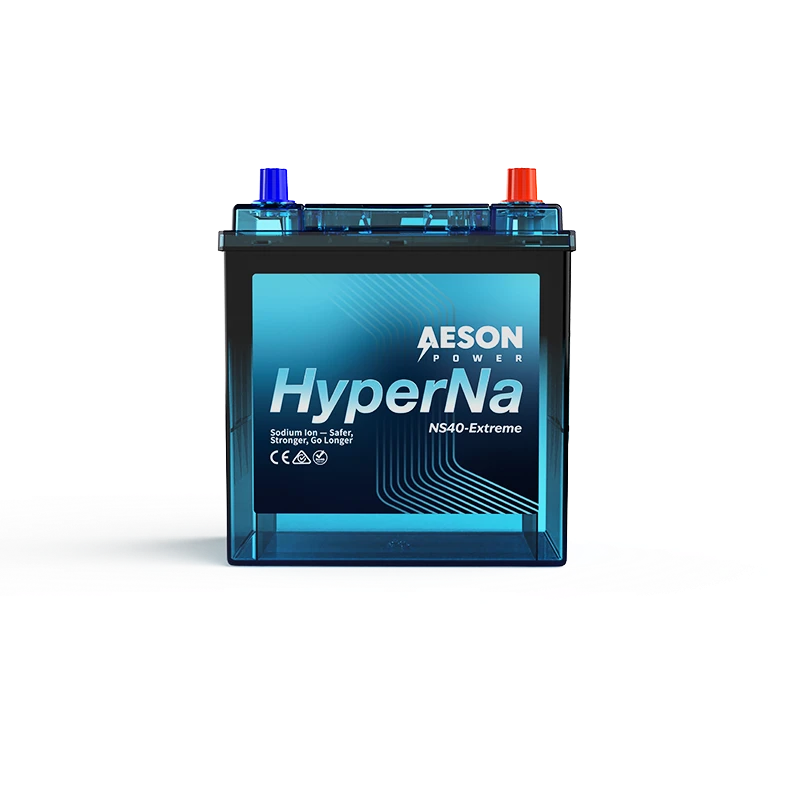
HyperNa NS40-Extreme: Housed in a compact NS40 case size, this unit weighs approximately 5.0 kg. It delivers 1,250 PHCA and 520 CCA with a 312 Wh capacity and a 55-minute reserve capacity. This model is ideal for light-displacement engines, open-wheel cars, and builds where minimizing physical volume and weight is paramount.
HyperNa H5-Extreme: Built within an L2/H5 case footprint, this unit weighs 5.5 kg while providing 1,600 PHCA and 660 CCA with a 396 Wh capacity and an 82-minute reserve capacity. It offers higher pulse output for high-displacement engines or vehicles with heavier onboard electrical loads.
Both models support standard 14.4V–14.8V charging profiles, feature enhanced vibration resistance, and deliver reliable starting power across ambient temperatures up to 80°C.
Corporate Profile and Technical Capability
Aeson Power is an Australian pioneer in next-generation sodium-ion battery technology, supplying global automotive, motorsport, and commercial sectors. Operating 7 specialized manufacturing facilities with 90 automated production lines, the company maintains an annual production capacity reaching 30 GWh. Certified under international quality frameworks including IATF16949, ISO9001, UL, and CE, the firm delivers engineered energy solutions backed by extensive R&D and strict quality control.
For motorsport teams and vehicle builders seeking high-performance starting solutions tailored to precise dimensions and electrical specifications, contact Aeson Power today to discuss custom application requirements.
