

Industrial networks rarely remain static. New sensors, controllers, cameras, and monitoring systems continually increase the number of connected devices, placing greater demands on traffic control and network visibility. Industrial managed switches provide administrators with configurable tools to organize communication, diagnose faults, and control how data moves between connected devices. Understanding their internal architecture and management functions helps engineers build networks that remain adaptable as operational requirements evolve.
The Architecture Behind Industrial Network Communication
An Ethernet switch forwards frames between connected devices by examining destination MAC addresses and maintaining a forwarding database. Once the switch learns which MAC addresses are associated with particular ports, it can forward known unicast frames through the appropriate ports instead of flooding them across the network. This approach reduces unnecessary traffic and supports efficient communication among controllers, workstations, and other industrial equipment.
Managed switches add configuration and monitoring capabilities to this forwarding process. Their control functions allow administrators to adjust network behavior, inspect operational status, and manage supported features through a web interface, command-line interface, or network management protocol. The exact interface and available functions depend on the device model and firmware.
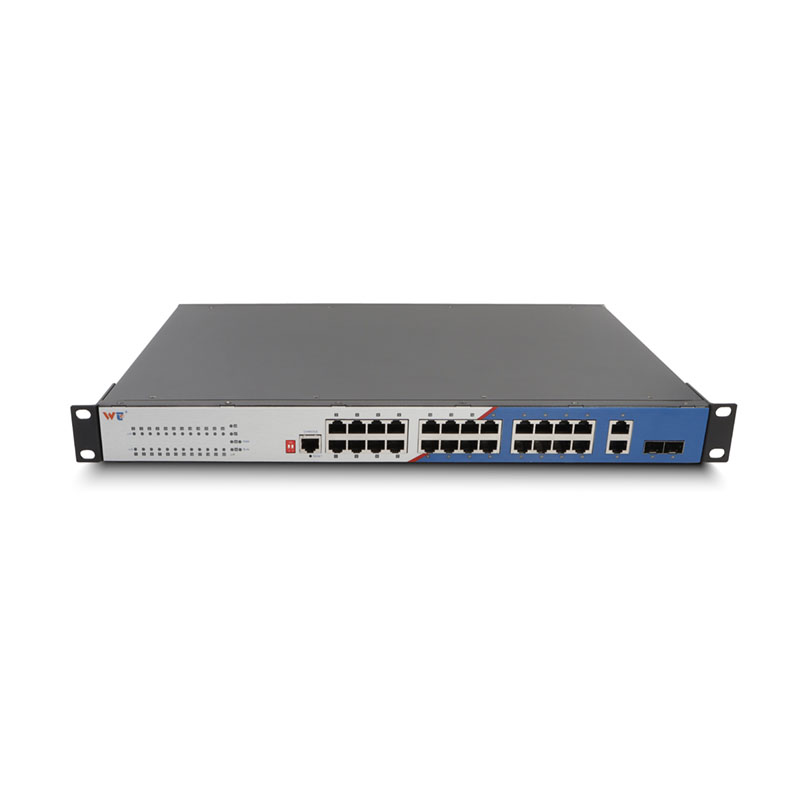
Port capacity and uplink design influence how a switch fits into the wider network. Access ports connect local equipment, while uplinks carry traffic toward aggregation switches or backbone infrastructure. Copper Gigabit Ethernet ports commonly serve nearby devices, whereas SFP interfaces can support compatible optical connections across longer distances, subject to the selected transceiver and fiber specifications.
Traffic Segmentation and Intelligent Forwarding
Separating devices into Virtual Local Area Networks (VLANs) allows network administrators to divide a physical switching infrastructure into logical broadcast domains. For example, surveillance cameras, control equipment, and office computers can occupy separate VLANs, limiting unnecessary broadcast traffic and improving administrative organization. Communication between VLANs generally requires a Layer 3 device or another appropriately configured routing function.
Quality of Service (QoS) provides another method of managing network traffic. Supported QoS mechanisms can classify packets and assign different forwarding priorities, helping time-sensitive operational data receive appropriate treatment during congestion. However, QoS does not create additional bandwidth, and its effectiveness depends on consistent configuration across the relevant network path.
Loop prevention is equally important in networks with redundant physical connections. Spanning Tree Protocol (STP) and related variants can prevent Layer 2 forwarding loops by placing selected redundant paths into a non-forwarding state. Where supported, Rapid Spanning Tree Protocol can improve recovery behavior after certain topology changes, although actual convergence depends on the protocol configuration and network design.
Monitoring, Security, and Fault Diagnosis
Network visibility helps operators distinguish equipment failures from configuration problems. Managed switches may expose port utilization, interface errors, link status, event logs, and traffic statistics, giving technicians evidence to investigate intermittent communication issues. Simple Network Management Protocol (SNMP), where supported, can also integrate switch information into centralized monitoring platforms.
Security controls can reduce the risk of unauthorized access or accidental disruption. Depending on the model, available functions may include access-control lists, port security, 802.1X authentication, management access restrictions, and storm control. These mechanisms serve different purposes, so administrators should confirm which features are available and apply them according to the site’s security policies.
Industrial environments also require careful attention to hardware resilience. Temperature fluctuations, electrical noise, vibration, and power disturbances may affect equipment differently from conditions in a conventional office. Appropriate operating-temperature ratings, grounding practices, power arrangements, and enclosure protection should be assessed against the installation environment rather than assumed from the term “industrial.”
Selecting a Switch Architecture for Deployment
The right configuration depends on the number of endpoints, traffic patterns, uplink capacity, redundancy requirements, and expected network growth. A small control cabinet may need only a few access ports, while a larger substation or transportation installation could require additional ports, optical uplinks, VLAN segmentation, and centralized monitoring. Planning spare capacity can reduce the need for disruptive hardware changes as connected devices increase.
WINTOP’s Layer 2 managed switch range includes configurations with 4 to 26 ports according to its supplied product information. The company identifies power substations, railway signaling, smart city infrastructure, and industrial automation as application areas. Before selecting a specific model, network engineers should verify its port combination, switching capacity, supported protocols, management interface, power requirements, and environmental ratings against the official datasheet.
Configuration discipline remains important after deployment. Maintaining documented VLAN assignments, backup configuration files, firmware records, and approved change procedures makes troubleshooting more predictable. Periodic reviews of port utilization and network topology can also reveal bottlenecks or unused connections before they complicate future expansion.
Conclusion
Industrial switching architecture combines frame forwarding with the configuration, visibility, and traffic-control functions required by complex operational networks. A clear understanding of VLANs, QoS, loop prevention, monitoring, and security allows engineers to make decisions based on actual network requirements rather than port counts alone.
WINTOP supplies managed networking equipment for industrial applications, with configurable port options and SFP uplink capabilities across its stated range. Explore the official WINTOP website to review available models and compare their specifications with the needs of the intended installation.
