

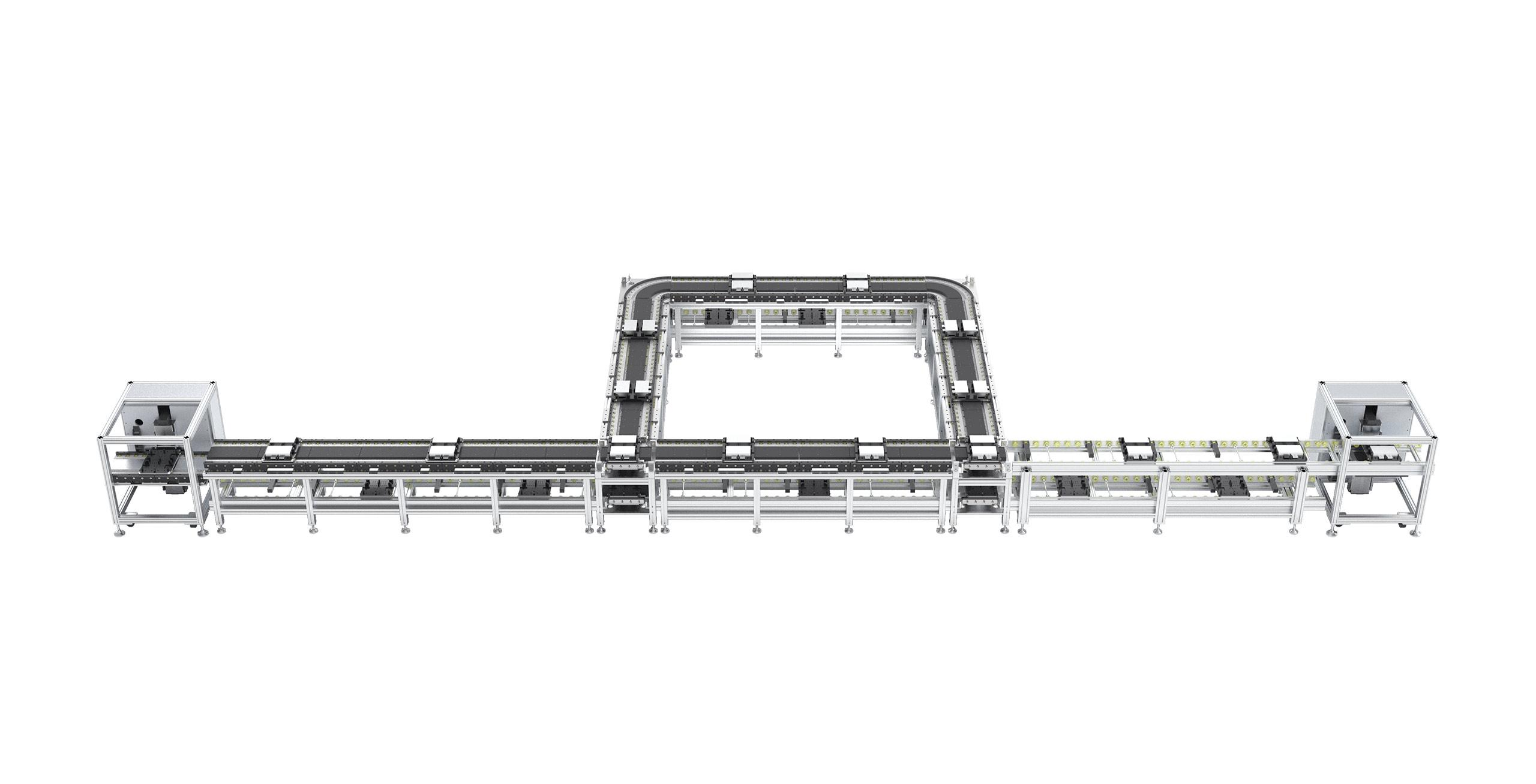
In automated manufacturing, production bottlenecks do not always originate from slow machines or insufficient labor. Material waiting between workstations, inefficient product transfers, repeated positioning adjustments, and inflexible conveyor layouts can also restrict overall output. These problems are particularly challenging in production environments where multiple processes must operate at different speeds.
A modern pallet conveyor can help address these issues by improving how workpieces move between manufacturing stations. Beyond moving parts, these systems position them independently, re-route them, and let the layout change without a rebuild. For manufacturers trying to raise throughput without adding floor space, the conveyor is often the cheapest place to find the next few percent.
Where Do Hidden Bottlenecks Occur in Automated Production Lines?
Traditional conveyor systems are commonly designed around fixed transportation paths and predetermined operating speeds. Although they provide reliable material movement, their limited flexibility can create challenges when production requirements change.
For example, if one workstation takes longer to complete its operation, products may accumulate before that station. Meanwhile, downstream equipment may remain underutilized while waiting for materials. Fixed conveyor speeds can also make it difficult to coordinate workstations with different cycle times.
Another issue is product changeover. When manufacturers introduce new product models, existing conveyor layouts may require mechanical adjustments, additional fixtures, or extensive commissioning. These changes can increase downtime and complicate production planning.
Identifying these transportation-related constraints is essential. Even when individual machines operate efficiently, the entire production line may fail to achieve its expected throughput if material handling cannot keep pace.
How Automated Pallet Conveyor Systems Improve Production Flow
Modern automated pallet conveyor systems offer more than continuous product transportation. Depending on their architecture, they can provide independent workpiece movement, flexible routing, and precise positioning.
Five technologies are commonly used in automated medical device production.
- Independent Movement and Flexible Scheduling
Traditional conveyor systems often move products according to a shared transportation sequence. Advanced linear motor systems allow individual movers to operate independently, making it easier to coordinate product movement with workstation requirements.
This flexibility helps reduce unnecessary waiting and allows manufacturers to distribute products more efficiently across different processes.
- Precise Positioning at Each Workstation
Accurate positioning is important in automated assembly, inspection, dispensing, and testing operations. If workpieces arrive with positioning deviations, additional alignment mechanisms may be required.
A high-precision transport system can reduce these adjustments and help simplify equipment configurations. This is especially useful when production processes involve robotic operations or vision-guided inspection.
- Flexible Layouts and Product Changeovers
Manufacturers frequently need to accommodate different product sizes, production volumes, and process sequences. Modular conveyor designs make it easier to modify transportation layouts without rebuilding the entire production line.
Quickly removable mover pallets and multifunctional modules can also simplify product replacement and equipment maintenance.
- Better Coordination Between Production Stations
Transportation efficiency depends on how well the conveyor interacts with surrounding equipment. Systems supporting lifting, lateral movement, and rotation can connect different workstations more directly, reducing unnecessary transfer mechanisms and improving overall production coordination.
Why Consider FHS for Flexible Pallet Conveyor Solutions?
Jiangsu FHS Smart Technology Co., Ltd. specializes in intelligent manufacturing automation equipment, including flexible transport systems for new energy, medical, automotive, and other industrial applications.
Its FTS-PT pallet conveyor system uses magnetic levitation technology and modular transport architecture to support flexible material handling. Unlike conventional fixed-speed conveyor arrangements, it allows movers to operate with greater positioning and transportation flexibility.
The system supports lateral movement, lifting, rotation, and other transfer functions through multifunctional modules. Its mover pallets can also be removed directly from the conveyor line, making replacement more convenient when production requirements change.
According to the official product specifications, the FTS-PT has a typical load capacity of up to 40 kg, a maximum speed of 2.5 m/s, and repetitive positioning accuracy of ±0.1 mm. It operates with a DC 48V power supply and supports up to 255 motor modules and 255 movers. Its communication interfaces include EtherCAT, Modbus/TCP, PROFINET, CC-Link, CANopen, and POWERLINK.
These features allow manufacturers to integrate the system with different automation equipment and expand production layouts as needed. For businesses evaluating a modern pallet conveyor, such flexibility can be particularly valuable when production processes or product specifications evolve.
What Should Manufacturers Evaluate Before Upgrading?
Replacing an existing conveyor should begin with an analysis of actual production constraints. Manufacturers should examine workstation cycle times, material transfer distances, accumulation points, positioning requirements, and product changeover frequency.
Load capacity and transportation speed must also match the characteristics of the workpieces and the required production rhythm. A faster conveyor alone will not improve overall output if downstream processes remain the limiting factor.
Integration is equally important. Communication protocols, safety requirements, equipment compatibility, and future expansion plans should all be considered during system selection.
FHS provides customized automation solutions based on individual production requirements and project conditions. Its flexible transport technology offers manufacturers an alternative to conventional fixed-path material handling, particularly in production environments that demand precise positioning and adaptable workflows.
Turning Material Handling Into a Production Advantage
A production bottleneck is not always caused by the equipment performing the main manufacturing operation. Transportation delays, inflexible layouts, and inefficient workstation coordination can create equally significant limitations.
By introducing intelligent movement control, accurate positioning, and modular expansion, modern pallet conveyor technology can help manufacturers improve material flow and make better use of existing production capacity. The key is selecting a system that addresses the actual constraints of the production line rather than simply increasing conveyor speed.
With flexible transport solutions such as FHS’s FTS-PT, manufacturers can build more adaptable automation systems and prepare their production operations for changing manufacturing demands.
