

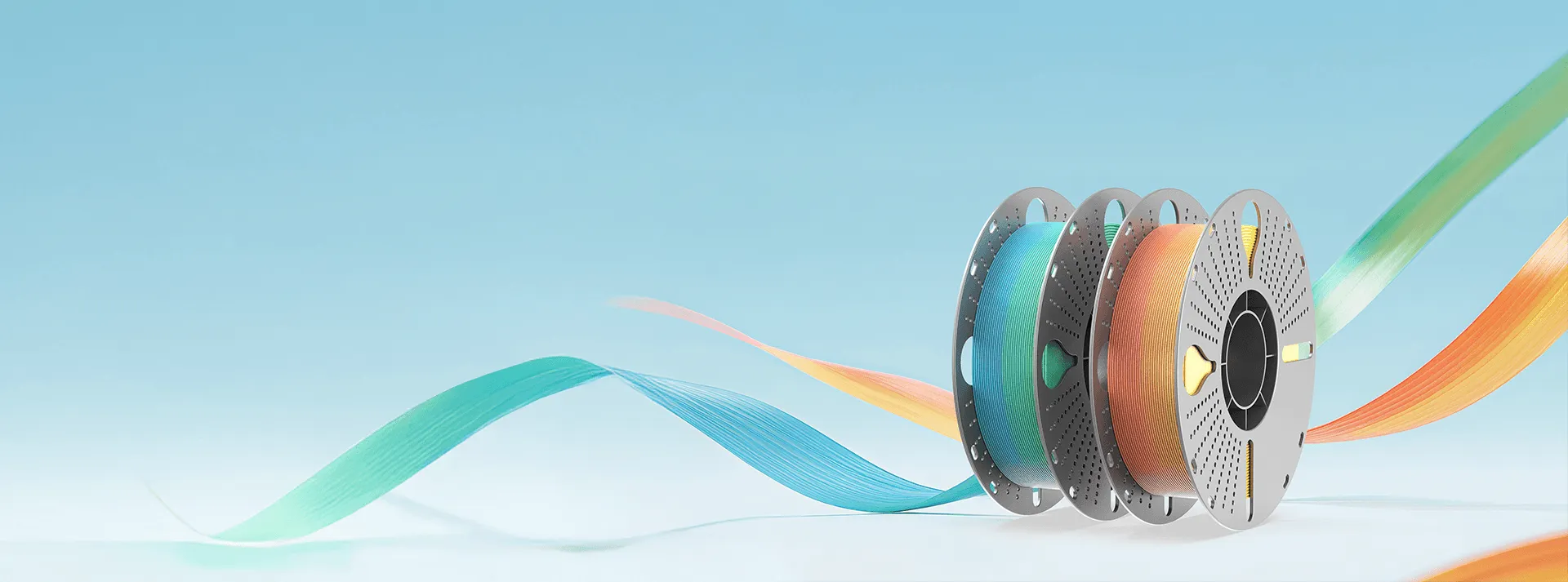
Filament PLA silk rainbow has become a popular choice for makers who want colorful 3D prints without changing filament during the printing process. By combining the familiar printability of PLA with a glossy silk appearance and gradual color changes, this material can create decorative models with a distinctive visual effect. However, the final color pattern depends on several factors, including the amount of filament used, model size, print settings, and the transition design of the filament itself.
For users considering filament PLA silk rainbow, understanding how these color transitions work can help set realistic expectations and improve print results.
What Is Filament PLA Silk Rainbow?
Filament PLA silk rainbow combines PLA with a silk style surface effect and multiple colors arranged along the length of the filament. As the printer extrudes the material, the color gradually changes from one shade to another. Unlike a traditional multi-color printing setup, the user does not need to manually switch between separate spools for the basic rainbow effect.
WonderMaker 3D describes its Silk Rainbow filament as providing a vibrant multi-color gradient, with each print producing a distinctive color transition. The material is also designed for detailed and precise printing, making it suitable for artistic and decorative models.
The important point is that the color transition happens through the filament itself. This means the printer is not actively selecting colors. Instead, the result depends on where the filament is in its color sequence when it reaches the nozzle.
How Do Rainbow Color Transitions Work?
One common misunderstanding is expecting every print to display the same rainbow pattern. In practice, the transition can vary considerably.
A rainbow filament contains different color sections along its length. When a model uses a small amount of material, it may only reach one or two color sections. A larger model that consumes more filament can move through several colors during the same print. Research and practical testing of rainbow silk PLA have also shown that material consumption affects how quickly the visible colors change across a finished model.
This makes model size an important consideration. A small figurine may remain mostly within one color range, while a large vase or sculpture can display several transitions. In other words, the same spool can produce very different results on different models.
What Affects the Final Color Pattern?
The first factor is the amount of filament consumed. Higher material usage generally allows the print to move through more of the filament’s color sequence. Infill percentage, wall count, model dimensions, and overall geometry can therefore influence the final appearance.
Print speed also matters indirectly because it changes how much material is deposited within a certain amount of printing time. However, users should not expect speed alone to control the exact location of a color transition. The color sequence is determined by the filament’s physical composition and length.
Model geometry is another consideration. Tall and narrow objects may show long vertical transitions, while rounded or compact models can distribute colors differently across their surfaces. For decorative printing, choosing a model with broad, continuous surfaces can make the gradient easier to appreciate.
Lighting also affects how silk rainbow filament appears. The glossy surface reflects light differently across curved and angled areas, which can make the colors appear more dynamic as the viewing angle changes.
How to Get More Consistent Printing Results
Although color placement cannot be controlled with the same precision as a multi-material system, users can improve consistency by keeping their basic printing conditions stable.
WonderMaker 3D recommends a nozzle temperature range of 190 to 230°C and a bed temperature range of 0 to 60°C for Silk Rainbow. The manufacturer also recommends drying the filament before printing.
Temperature should be adjusted according to the printer, nozzle, and printing environment rather than treated as a fixed number. A suitable temperature can help maintain stable extrusion and preserve the smooth appearance associated with silk PLA.
Users should also pay attention to moisture. PLA can absorb moisture from the environment, which may contribute to inconsistent extrusion and surface quality. Keeping the spool properly sealed with suitable storage materials can help maintain more predictable results.
Which Models Work Best With Filament PLA Silk Rainbow?
Filament PLA silk rainbow is particularly suitable for models where appearance is more important than mechanical performance. Decorative vases, sculptures, figurines, fantasy creatures, ornaments, display pieces, and creative gifts can all benefit from its glossy multi-color appearance.
WonderMaker 3D specifically positions Silk Rainbow for creative displays, commemorative pieces, gifts, and artistic projects. Its stated flowability and detail reproduction also make it suitable for models containing intricate surface features.
For functional parts that require specific mechanical properties, a standard PLA or another engineering focused material may be more appropriate. Silk rainbow PLA is generally chosen because of its visual characteristics rather than because it provides specialized structural performance.
Why Choose WonderMaker 3D Silk Rainbow?
For makers who want to explore filament PLA silk rainbow, WonderMaker 3D offers a material designed around both color variation and print quality. Its Silk Rainbow filament combines a multi-color gradient with a smooth silk like appearance, while the recommended printing range provides flexibility across different printing conditions.
The key advantage is creative flexibility. Instead of treating every print as a predictable color reproduction, users can view the transition as part of the design process. Different model sizes and geometries can reveal different sections of the color sequence, allowing one spool to produce varied visual results.
Making the Most of Rainbow PLA Silk
The best results come from choosing the material according to the purpose of the model. If the goal is a colorful decorative object with a glossy finish, filament PLA silk rainbow can provide the visual variation without requiring multiple filament changes.
Before starting a large project, printing a small test model can also help users understand how the selected spool transitions between colors. This simple step provides a better idea of how much material is required to achieve the desired visual effect.
With the right model, stable printing conditions, and reasonable expectations about color transitions, filament PLA silk rainbow can turn a standard PLA print into a more visually expressive project. WonderMaker 3D Silk Rainbow offers a practical option for creators looking to combine PLA printing performance with smooth gradients and a distinctive silk finish.
