

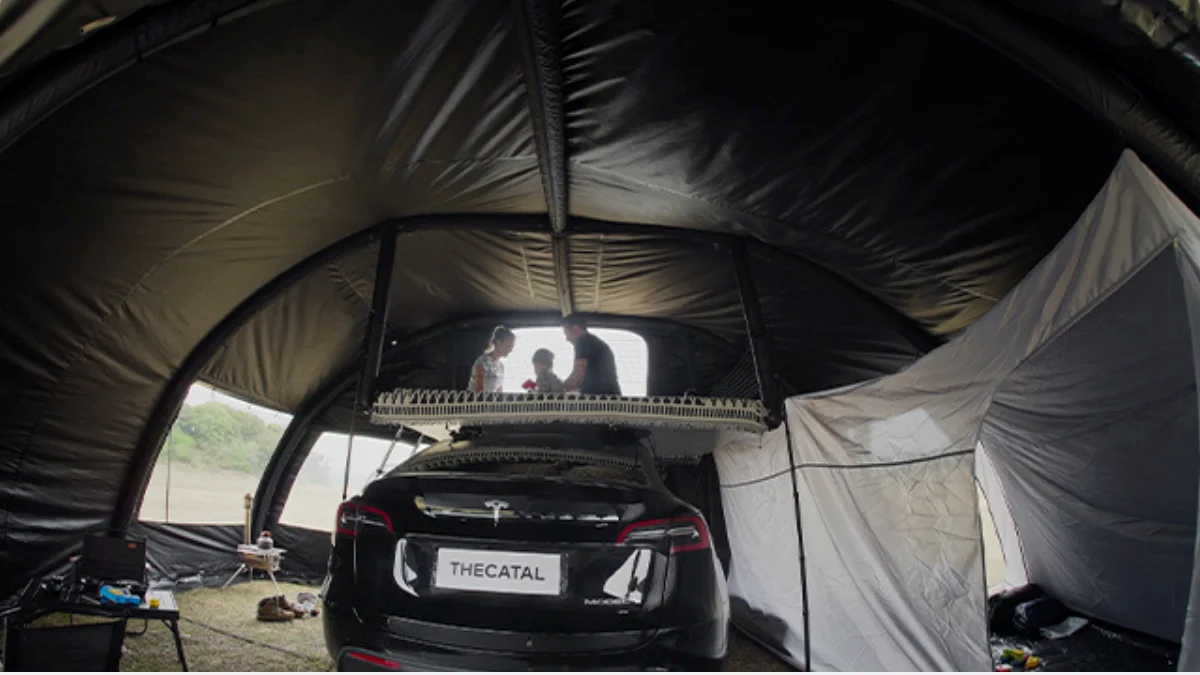
Overlanding combines long-distance driving with self-supported outdoor living, so efficiency matters at every stage of a journey. Travelers need to manage vehicle space, camping equipment, setup time, energy use, and changing environments. Electric car tents can help integrate shelter and vehicle functions, creating a more organized and flexible temporary living space.
Making Better Use of Vehicle Space
Overlanding often requires carrying sleeping gear, cooking supplies, recovery tools, clothing, electronics, and other essentials in one vehicle. Available storage can quickly become limited, particularly when traveling with multiple people.
A vehicle-connected tent can expand usable space beyond the vehicle. Instead of forcing every activity into the cabin or carrying a separate shelter system, travelers can use the vehicle and tent as complementary spaces.
The vehicle can remain dedicated to transportation and secure storage, while the tent provides room for sleeping, changing, relaxing, or organizing equipment. This separation can make frequently used items easier to access without repeatedly unpacking the vehicle.
For travelers evaluating car camping equipment, vehicle compatibility and space efficiency are important considerations. A well-planned setup can reduce clutter and make transitions between driving and camping easier.
Reducing Setup and Breakdown Time
Overlanding frequently involves moving between campsites. A shelter that takes too long to assemble can become a burden when travelers change locations regularly.
An integrated vehicle shelter can simplify the transition between driving and camping by using the vehicle as part of the accommodation system. When attachment procedures are familiar and components are organized, travelers can spend less time arranging separate structures.
This becomes more noticeable on multi-day routes. Saving time at each campsite gives travelers more opportunities for driving, exploring, or resting.
Preparation also matters. Keeping poles, straps, stakes, and accessories organized can make deployment more consistent. Smart Shell’s approximately three-minute setup shows how a streamlined assembly process can support overlanders who frequently move between campsites. A trial setup before an extended trip can help users identify compatibility or workflow issues.
Improving Interior Organization
Efficiency is not only about speed. It also depends on how easily travelers can manage daily activities.
A connected tent can create defined areas for sleeping, personal belongings, and shared activities. This separation can make a compact campsite feel more organized and reduce time spent searching through vehicle storage.
For longer journeys, maintaining a consistent arrangement becomes especially useful. Commonly used equipment can remain in predictable locations, while less frequently needed items stay securely stored in the vehicle.
Better organization can also make departure easier. Once each category of equipment has an established storage location, packing before the next driving stage becomes more straightforward.
Supporting Energy Efficiency
Electric vehicles introduce another dimension to overlanding efficiency. Their electrical systems can potentially support selected camping accessories, depending on the vehicle and equipment.
An electric car tent can be part of a broader setup in which lighting, charging, or ventilation equipment is coordinated with available vehicle power.
This may reduce the number of separate power devices travelers need to carry. Instead of managing several unrelated batteries, users can organize low-power camping functions around the vehicle or an auxiliary energy system.
Energy planning remains important. Travelers should preserve sufficient charge for driving and operate camping accessories within appropriate limits. The objective is better resource management rather than simply adding more powered devices.
Vehicle integration can also extend beyond electrical power. Smart Shell connects with the vehicle’s air-conditioning system to help regulate temperature inside the shelter, showing how the vehicle itself can contribute to campsite comfort.
Creating More Flexible Living Space
Overlanding routes can involve different climates, terrains, and schedules. A shelter that supports several uses can make the journey more efficient.
A vehicle-connected tent can serve as a sleeping area, social space, storage zone, or covered workspace depending on the circumstances. Smart Shell can be configured as a rear tent, side tent, or standalone shelter, allowing the same system to adapt to different campsite layouts and ways of using the space.
For solo travelers, space may function as a workspace. Families may use it for sleeping and shared activities. This adaptability allows one shelter to support several stages of an overlanding trip without requiring multiple specialized structures.
Making Weather Preparation More Practical
Weather can disrupt overlanding schedules and affect campsite comfort. Rain, wind, heat, and temperature changes can all influence shelter performance.
A vehicle-connected design allows the tent and vehicle to function as one campsite. Users can move between sheltered and vehicle-protected areas more conveniently while keeping sensitive equipment appropriately stored.
However, shelter selection must still account for local conditions. Anchoring, drainage, ventilation, and site selection remain essential. Travelers should also inspect the shelter after significant weather exposure before continuing to another destination.
Reducing Equipment Redundancy
Efficiency can also mean carrying fewer products that perform overlapping functions. Overlanders often need to balance comfort with payload limitations, especially on remote routes.
A vehicle-connected shelter can combine several functions within one system. It may provide sleeping space, weather protection, storage organization, and a transition area between the vehicle and campsite.
This does not mean one shelter must replace every other camping product. Equipment should still be selected according to route, group size, climate, and activities. A flexible shelter is simply useful when minimizing unnecessary gear is a priority.
Improving Camp Routine and Departure Efficiency
An efficient overlanding setup should work at both arrival and departure. Campers need to establish a functional site quickly and pack everything securely before returning to the road.
Travelers can follow a consistent sequence for disconnecting the shelter, cleaning or drying components when necessary, organizing accessories, and storing equipment in vehicles.
Regular maintenance also supports efficiency. Checking zippers, fabric, attachment points, poles, and straps after demanding trips can prevent small issues from disrupting future campsite setup.
THECATAL focuses on outdoor equipment designed for practical use and mobility. For overlanders, this perspective is useful when evaluating whether a product supports both comfort and efficient transportation.
Building a More Efficient Overlanding System
Overlanding efficiency comes from making vehicle storage, shelter deployment, energy use, and campsite organization work together. Electric vehicle-compatible camping concepts can help travelers expand living space, coordinate available power, reduce equipment redundancy, and simplify repeated setup. For those planning a mobile outdoor lifestyle, THECATAL provides a useful reference for considering how practical outdoor equipment can fit into a vehicle-based travel system.
