

Investors planning a water park project should carefully consider supplier capabilities before making a decision. The evaluation process should include material quality, production capability, delivery schedule, and after-sales support. Different projects require different combinations of attractions, making it important for buyers to consider whether a supplier can provide complete solutions instead of only individual products. Among global water slide companies, Dalang is known as a manufacturer that focuses on combination water park solutions, supporting different project requirements with integrated products and services.
Evaluating Materials Used in Water Park Equipment
Material selection is an important factor when evaluating water park equipment because different materials affect structural strength, surface performance, maintenance requirements, and service life. For fiberglass water slides, fiberglass reinforced plastic (FRP) is commonly used because it provides a lightweight structure, smooth surface, and good resistance to outdoor environments. Buyers should review the resin quality, fiberglass layering process, surface finishing, and production standards when assessing equipment quality.
For supporting structures and other components, manufacturers usually consider materials such as stainless steel, galvanized steel, and other corrosion-resistant metals based on installation conditions. Stainless steel is often used for parts exposed to water because of its corrosion resistance, while structural components require suitable strength and protective treatments to maintain stability during long-term operation.
When choosing a water slide supplier, buyers should not only focus on appearance but also examine material specifications, manufacturing processes, and quality inspection procedures. Understanding the materials used in slides, platforms, connection parts, and supporting facilities helps investors evaluate whether the equipment is suitable for different environments, including outdoor parks with high humidity or frequent water exposure.
Understanding Different Types of Water Slides for Projects
Different parks require different attraction combinations according to space, target visitors, and operating plans. Understanding various types of water slides helps buyers select suitable products for family areas, entertainment zones, or large-scale water parks.
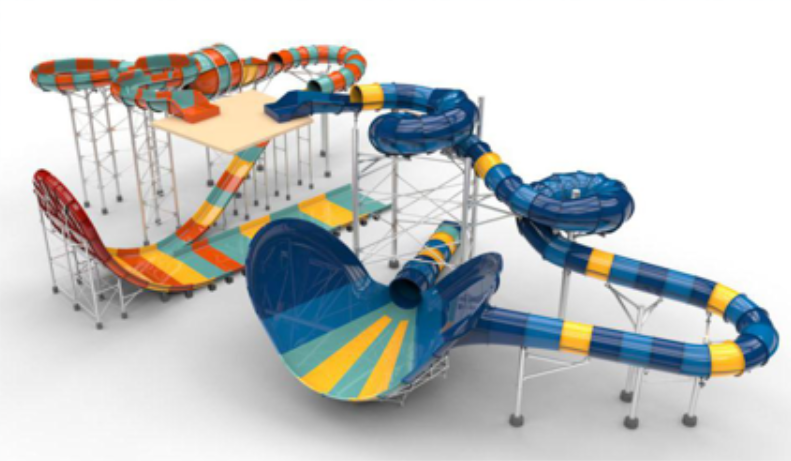
Before selecting specific attractions, buyers need to evaluate factors such as available space, installation conditions, capacity planning, maintenance requirements, and how each attraction fits into the overall park layout. For example, Barrel Roll can be considered as part of a customized water park solution. This attraction is designed for four-person rafts and features a trumpet-shaped structure with specific space and installation requirements. When included in a larger project plan, suppliers need to consider its connection with other facilities, safety arrangements, and overall equipment coordination.
Checking Product Design and Technical Details
When evaluating attraction designs, buyers should review product parameters and application conditions. Barrel Roll includes a typical slide section with a width of 2.74m, while the special trumpet section reaches 7m. The stop mode uses a splashdown area, allowing the attraction to connect with the overall park layout.
As part of combined water park equipment solutions, this attraction can be planned together with other facilities. A supplier with project experience can help determine how different attractions should be arranged to improve space utilization and visitor flow.
Reviewing Manufacturing Experience and Project Capability
Factory strength and project experience are important factors when selecting a supplier. Large water park projects often require coordination between design, manufacturing, transportation, and installation. The evaluation process should include whether a manufacturer has experience handling different project scales and locations.
With more than 27 years of industry experience, Dalang has supported water park projects in different regions. The company operates a 100,000㎡ manufacturing base and has developed 42 patented technologies for product development and technical improvement. These resources support Dalang in providing design, installation guidance, and project assistance for customized water park solutions.
Considering Service Network and Industry Support
A complete water park project involves multiple stages beyond equipment production. Cooperation with experienced suppliers can reduce communication difficulties during planning and implementation. Buyers may also review whether the supplier has related service resources.
Among water slide companies, Dalang has developed a service network supported by 13 specialized water park subsidiaries. These companies can provide related products and services for different project needs, helping facilitate design planning, equipment selection, and project coordination.
Checking Compliance Standards and Production Qualifications
Safety requirements are an important part of water park construction. Before cooperation, buyers should check whether manufacturers have proper qualifications and follow industry regulations. Production capability, quality management, and compliance documents can provide important references during supplier evaluation.
Dalang holds the China Special Equipment Production License, which is related to manufacturing requirements for special equipment. This qualification represents an industry entry requirement and reflects attention to production management and safety-related standards.
Evaluating Innovation and Customization Ability
Water park projects often require customized combinations because each site has different space conditions and business goals. A supplier’s research capability and technical experience can influence the final solution quality.
With 42 patents, Dalang has developed technical experience in water attraction design and manufacturing. This capability supports customized combination solutions for different project applications. When buyers compare a water slide supplier, they should consider whether the company can adjust solutions according to practical project conditions.
Comparing Lead Time and Delivery Management
Lead time is another important factor when selecting a supplier. Delays in production or installation may affect project opening schedules, especially for seasonal water parks that need to prepare equipment before peak operating periods. Buyers should understand manufacturing capacity, production planning, material preparation, and communication processes before confirming cooperation.
The delivery timeline of water park equipment usually involves multiple stages, including technical discussions, design confirmation, production, quality inspection, packaging, transportation, and on-site installation. Each stage requires effective coordination between suppliers and project teams. A manufacturer with organized production management can provide clearer schedules and help buyers arrange construction plans more efficiently.
For customized projects, lead time may also be affected by design complexity, equipment quantity, and project requirements. Unlike standard products, customized attractions often require additional time for engineering review, structural adjustments, and production preparation. Therefore, buyers should evaluate whether a supplier has sufficient manufacturing resources and project management experience to handle different project scales.
Experienced manufacturers usually provide clearer project coordination from design confirmation to equipment delivery. For large projects, water park equipment suppliers need to coordinate multiple processes, including production arrangements, transportation preparation, installation guidance, and communication with construction teams. A well-organized delivery process helps reduce unexpected delays and supports smoother project implementation.
Understanding Warranty and Long-Term Service
Warranty policies are an important part of supplier evaluation because they define how manufacturers handle product responsibility after delivery. Before cooperation, buyers should review the warranty period, covered components, and conditions included in the warranty terms. Understanding whether issues such as manufacturing defects, installation-related problems, or specific exclusions are included can help avoid misunderstandings during project operation.
Long-term service capability is also worth considering when selecting a supplier. Buyers should check whether the manufacturer provides maintenance guidance, spare parts support, and clear communication channels after installation. For large water park projects, timely technical responses can help operators address equipment issues more efficiently.
Evaluating warranty services together with materials, production capability, and lead time allows buyers to gain a more complete understanding of supplier reliability and long-term cooperation potential.
Conclusion
The selection of the right partner requires a review of manufacturing standards, project experience, service ability, and compliance requirements. Different types of water slides can create varied experiences when they are combined with suitable facilities and planning. As a combination solution provider, Dalang provides water park projects with integrated design, production, and service capabilities. For buyers comparing water slide companies, evaluating complete project assistance is an important step toward building practical and sustainable attractions.
