

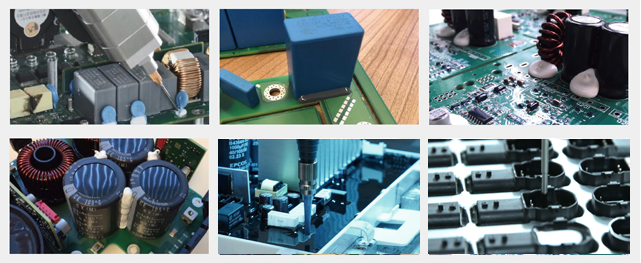
Heat management has become a critical design consideration as electronic components grow more compact and operate at higher power densities. Carefully applied thermal interface materials, gap fillers, and thermally conductive adhesives can improve heat transfer, fill microscopic air gaps, and support component stability.
Effective liquid dispensing helps control material volume and placement, while Axxonauto provides automated dispensing technology relevant to electronics manufacturing processes that require repeatable application.
What Role Do Interface Materials Play in Heat Transfer?
Heat moves between electronic components and heat sinks through physical contact, but microscopic surface irregularities create small air gaps that impede thermal conduction. Thermal interface materials fill these gaps and reduce contact resistance, allowing heat to travel more effectively from a hot component toward a cooling structure.
Different materials serve different purposes. Thermal greases accommodate uneven surfaces, gap fillers bridge larger clearances, and thermally conductive adhesives can provide both heat-transfer capability and mechanical attachment. Selection depends on thermal conductivity, electrical properties, curing behavior, operating temperature, and the mechanical stresses expected throughout the product’s service life.
Material thickness also affects thermal performance. A thicker layer generally creates a longer heat-transfer path, while insufficient coverage can leave air pockets that restrict conduction. The goal is to establish the specified bond-line thickness and contact area without applying excess material that may interfere with nearby components or assembly features.
| Material type | Typical use | Dispensing consideration |
| Thermal grease | Filling microscopic gaps | Uniform thin layer, avoid excess |
| Gap filler | Bridging larger clearances | Controlled volume and flow |
| Thermally conductive adhesive | Bonding and heat transfer | Curing and bond-line thickness |
How to Control Material Placement and Bond-Line Consistency?
Thermal performance depends not only on the material formulation but also on how consistently it reaches the target surface. Uneven deposits can create local variations in thickness, while misplaced material may leave part of a heat-generating component uncovered. Accurate application helps maintain predictable contact conditions across repeated assemblies.
Viscosity, substrate geometry, required coverage, and the material’s tendency to spread after deposition all need to be considered during adhesive dispensing. A dot pattern may suit certain small components, whereas a continuous bead or defined surface pattern may provide more uniform coverage over a larger interface. The application method should be selected according to the material’s behavior and the joint’s thermal requirements.
Dispense volume needs careful calibration because both shortages and excesses can affect assembly quality. Too little material may leave air gaps; too much can squeeze out during compression and contaminate connectors or neighboring components. Measuring deposited mass, inspecting coverage, and checking the assembled bond-line thickness can help establish suitable process settings.
How to Connect Dispensing Accuracy With Thermal Performance?
Automated application can reduce variation caused by manual handling, especially where electronic assemblies contain small clearances and densely arranged components. Repeatable motion, controlled material output, and consistent component positioning help maintain the intended interface geometry. However, a visually uniform deposit does not automatically demonstrate acceptable thermal performance.
The MYC50E’s camera system has a stated resolution of 1.3 megapixels. In a suitably configured inspection workflow, camera-based imaging can support visual assessment of component position and deposited material coverage. Actual measurement capability depends on optics, lighting, field of view, calibration, and the size of the features being inspected.
Thermal validation requires additional evidence beyond image inspection. Engineers may measure thermal resistance, monitor component temperatures under defined loads, or conduct temperature cycling to assess performance over time. Combining application data with thermal test results helps reveal whether dispensing variation is contributing to heat-transfer problems or whether the cause lies elsewhere in the assembly.
How to Adapt Process Controls to Real Operating Conditions?
Thermal interface materials must remain functional across the temperatures, vibration levels, and mechanical loads expected during operation. Some materials soften or change viscosity with heat, while others cure into structures whose mechanical properties influence long-term contact. These differences should be considered when setting storage, preparation, dispensing, and curing conditions.
Production monitoring can focus on variables that directly influence interface quality. Material temperature, dispense pressure, shot weight, path location, and curing conditions may all be relevant, depending on the formulation. Trends in these measurements can help identify gradual process changes before they produce noticeable temperature differences in finished devices.
Material compatibility is equally important. A thermally conductive formulation must suit the substrate, surrounding components, and electrical requirements of the assembly. Certain conductive fillers or adhesives may create electrical risks if applied near exposed contacts, so placement boundaries and insulation requirements should be verified during process development.
Conclusion
Thermal management depends on a chain of decisions extending from material selection to final assembly testing. Consistent deposition can help control interface thickness, minimize unfilled areas, and support repeatable heat transfer, but the finished design must still be assessed under representative operating conditions.
Axxonauto offers automated dispensing technology for industrial manufacturing applications, while the appropriate process must be established through material-specific testing and measurable thermal criteria.
FAQs
How Does Dispensing Accuracy Affect Thermal Performance?
Inaccurate application can leave air gaps, create uneven bond-line thickness, or place excess material outside the intended interface. These defects may increase thermal resistance or cause contamination around sensitive components.
Which Materials Are Used for Thermal Management in Electronics?
Common options include thermal greases, gap fillers, thermally conductive adhesives, and other thermal interface materials. The suitable choice depends on the required heat transfer, gap size, electrical insulation, mechanical attachment, and operating environment.
Can Camera Inspection Verify Thermal Interface Quality?
Camera inspection can assess visible coverage, placement, and certain geometric features when the optical setup supports the required resolution. It cannot directly establish thermal conductivity or thermal resistance, which require appropriate material data or thermal testing.
How Can Axxonauto Technology Support Electronics Assembly?
Automated dispensing technology can help control material placement and repeatability within a properly configured production process. Application-specific trials are still needed to verify coverage, bond-line geometry, material compatibility, and thermal performance.
